New Castle, PA · Serving surrounding communities

24/7 Emergency HVAC Service

PA# 184619

Home / HVAC Services / Furnace Service

Furnace Repair & Service in New Castle, PA

Furnace repair, heating service, and replacement options in New Castle, PA.

Furnace not heating your home?

Urgent heating or cooling problem? Call 412-629-3391 for 24/7 emergency service.

Furnace repair: what to tell us

Tell us if the furnace will not start, cycles repeatedly, or leaves rooms cold. Mention the fuel type and any thermostat message. We assess the equipment before explaining repair or replacement options.

Clear options before work begins

We diagnose the problem, explain what we found, and go over your options and the price. You approve the work before we repair or replace anything.

Service-call charges and approval

A diagnostic service call covers dispatch, diagnosis, and an explanation of your options. Repairs are separate and require approval. Emergency dispatch fees apply on weekends, holidays, and after hours; payment may be requested before dispatch.

Read the full service and emergency-charge explanation.

Told your furnace is condemned?

We offer free second opinions on condemned equipment. Call to discuss an assessment and available options. A second opinion does not mean equipment is safe to operate before it has been assessed.

Furnace maintenance: $89 Clean & Check

Regular price: $119 per system.
Offer covers one operating furnace or one operating air-conditioning system throughout our listed service area. Service-area eligibility confirmed when scheduling. Boilers and third-party home warranty customers are excluded. Repairs, additional cleaning, and diagnostic service calls are not included.
If equipment is inoperable upon arrival, the visit transitions to a diagnostic service call. The diagnostic fee applies instead of the $89 Clean & Check charge. Repairs and maintenance are quoted separately and require approval.

VIEW THE FURNACE CHECKLIST & CONDITIONS

Residential equipment we service

We service most residential heating and cooling equipment, including systems powered by natural gas, propane, and electricity. The brands we service are not limited to the brands we offer for new installations. Call with your equipment brand and model to confirm service availability.

We do not service oil-fired equipment or steam heating systems. We do not install customer-provided parts or equipment.

Understanding your heating problem

We can discuss the condition of your furnace and explain available repair options. Equipment age is one part of the decision; the current fault and your comfort goals matter too.

Considering a furnace replacement

Compare repair and replacement based on the findings for your home. Ask about equipment options and Wisetack financing through Housecall Pro, subject to approval and provider terms.

What does AFUE mean?

AFUE stands for Annual Fuel Utilization Efficiency. It describes how much of the fuel energy a furnace uses becomes useful heating over a typical heating season under standardized rating conditions.

An 80% AFUE furnace converts about 80% of its fuel energy into useful heat; a 97% AFUE furnace converts about 97%. The remaining energy is lost, largely through the exhaust. AFUE does not include heat lost through your home’s ductwork or the electricity used by the blower and other components.

A higher AFUE rating can reduce fuel use, but it is not a promise of a specific reduction in your utility bill. Weather, thermostat settings, fuel prices, ductwork, installation quality, and the condition of your existing equipment affect actual results.

80% versus 97% furnaces

80% AFUE: non-condensing

An 80% furnace releases more heat through its exhaust. It typically uses an approved metal venting system. Whether existing venting can be reused depends on its condition, sizing, the equipment instructions, and applicable requirements.

Installation can be simpler in some homes, but suitability and total installed cost still require an assessment.

97% AFUE: condensing

A 97% furnace recovers additional heat from combustion gases through a secondary heat exchanger. As those gases cool, moisture condenses, so the installation needs a suitable condensate drain and approved venting.

Venting routes, combustion-air arrangements, drainage, and available space must be checked. A high-efficiency replacement is not necessarily a direct swap into the existing vent.

The furnace and installation instructions determine approved vent materials and configurations. Where a furnace shares a chimney with another appliance, replacing it may also require changes to the remaining appliance’s venting.

Does 97% AFUE mean a 17% smaller heating bill?

Not directly. As a simplified comparison, delivering the same useful heat at 97% rather than 80% AFUE requires about 17.5% less fuel: 1 − (80 ÷ 97). That assumes both furnaces perform at their rated efficiency and heating demand stays the same. It is not a prediction of your total bill, which can include electricity, fixed charges, and other gas appliances.

Does a higher AFUE rating mean better comfort?

Efficiency and comfort are related but different. Proper sizing, airflow, ductwork, thermostat setup, and features such as staged heating or a variable-speed blower also matter. AFUE alone does not tell you which comfort features a furnace includes.

We assess job requirements and existing sizing before proposing equipment. If the sizing appears incorrect, a Manual J load calculation may be needed and charges may apply. Size changes may require ductwork redesign, modification, or replacement, which will be explained in the proposed scope.

Single-stage, two-stage, and modulating furnaces

Heating stages describe burner output. Variable speed usually describes the blower moving air through your home. They are separate features.

Single-stage

One heating output: the burner runs at its rated capacity when heating is needed, then shuts off. This offers straightforward operation.

Two-stage

Low and high heating outputs let the furnace use lower output for lighter demand and higher output when needed. Longer low-stage cycles can provide steadier temperatures and quieter operation.

Modulating heat

The burner adjusts output in smaller increments within its operating range to follow heating demand more closely. Available capacity steps and control requirements vary by model.

Variable-speed blower

The blower adjusts air delivery for different operating needs. A furnace can combine a variable-speed blower with two-stage or modulating heating; the blower description alone does not identify the burner type.

Which option is right for my home?

We compare your comfort goals, budget, equipment sizing, ductwork, and compatible controls. More stages do not fix undersized ducts, restricted airflow, or insulation problems. Compare AFUE separately when evaluating fuel efficiency.

Learn more about heating stages and variable-speed blowers

PSC, constant-torque, and variable-speed blower motors

The blower moves air through your furnace, filter, indoor coil, and ductwork. Its motor type affects electrical use and how it responds to airflow resistance.

PSC: conventional blower motor

Permanent split capacitor (PSC) motors are common in older equipment. They use a run capacitor and selected speed connections. They generally use more electricity than ECM motors, especially for low-speed circulation, and airflow drops as system resistance increases.

Constant-torque ECM

An electronically commutated motor (ECM) maintains a programmed torque setting. It offers improved motor efficiency and better airflow response than a typical PSC motor. Constant torque does not mean constant airflow: restrictions can still reduce air delivery.

Variable-speed / constant-airflow ECM

This type adjusts motor output to maintain a programmed airflow within its operating limits. Depending on the equipment and controls, benefits can include smoother starts, quieter low-speed operation, efficient circulation, and airflow choices that support cooling-season humidity control.

A constant-airflow motor may use more power as resistance rises. It cannot overcome unlimited restriction or repair undersized ductwork. ECM does not automatically mean constant airflow; the specific motor and equipment controls matter.

Every furnace needs the right airflow

Airflow is measured in CFM—cubic feet per minute. Static pressure describes resistance to airflow. Heating and cooling can require different blower settings; there is no single setting that suits every system.

Newer ECM blowers make airflow checks especially important

When upgrading to a constant-torque or variable-speed ECM blower, do not assume the existing ductwork and filter arrangement are adequate just because the old furnace operated. Both proper airflow and total external static pressure (TESP) need to be checked against the new equipment’s requirements.

TESP measures the combined resistance on the return and supply sides of the equipment at the manufacturer’s specified test locations. The measured pressure must be evaluated with the blower performance data, selected operating settings, and the manufacturer’s rules for accounting for filters and coils.

A constant-airflow ECM may increase its speed and electrical use to maintain the requested airflow as resistance rises, until it reaches its operating limits. A constant-torque ECM can lose airflow as resistance increases. Excessive restriction can therefore reduce performance, increase noise, and contribute to overheating or other operating problems. Neither motor type makes restrictive ductwork acceptable.

Correcting an installation may require changes to return or supply ductwork, the filter cabinet, or other restrictions—not simply turning up the blower. PSC systems also require proper airflow and static-pressure checks. There is no single acceptable TESP limit for every furnace; use the limits and airflow tables for the installed model.

  • Heating: Airflow must keep the temperature rise—the difference between return and supply air temperatures—within the furnace manufacturer’s specified range.
  • Cooling and heat pumps: Airflow must match the installed equipment and operating mode. Too little can affect performance and contribute to coil icing.
  • Ducts and filters: Return ducts, supply ducts, coils, filters, and grilles all affect resistance. Filter selection must account for its size and pressure drop, not just its MERV rating.
  • Setup: Check measured static pressure against the equipment limits and blower performance information. A more advanced motor does not remove the need for these checks.
Can I close vents or turn the blower down to get warmer air?

Do not use closed vents or blower adjustments to force hotter air. Restricted airflow can cause overheating and safety-limit shutdowns. Keep returns unobstructed, maintain the correct filter, and have airflow concerns assessed before changing equipment settings.

Why AHRI-matched heating and cooling equipment matters

When a furnace shares its blower and ductwork with central air conditioning or a heat pump, the equipment must work together. The outdoor unit, indoor coil, and furnace or air handler where specified in the rating need to form an appropriate combination.

AHRI—the Air-Conditioning, Heating, and Refrigeration Institute—certifies equipment performance ratings. An AHRI Certificate of Product Ratings identifies a rated combination and its certified performance. Matching brand names alone does not establish a certified match; the specific model numbers matter.

A furnace’s AFUE describes its fuel-heating efficiency. A matched air-conditioning or heat-pump system has separate cooling and, where applicable, heat-pump heating ratings. Installing a 97% furnace does not automatically give an existing air conditioner a higher certified efficiency.

Does replacing my furnace mean replacing the air conditioner too?

Not automatically. Compatibility, blower airflow, the indoor coil, controls, equipment condition, and manufacturer requirements need to be checked. If cooling or heat-pump performance ratings are part of a proposal, ask which equipment combination those ratings apply to and for the applicable AHRI reference number or certificate.

AHRI certification verifies rated equipment performance; it does not certify the quality of the installation or guarantee your home’s energy savings. Proper sizing, ductwork, airflow, and startup testing still matter.

Look up certified equipment in the AHRI Directory

Residential service from a New Castle business. View our service areas.

A look at our work

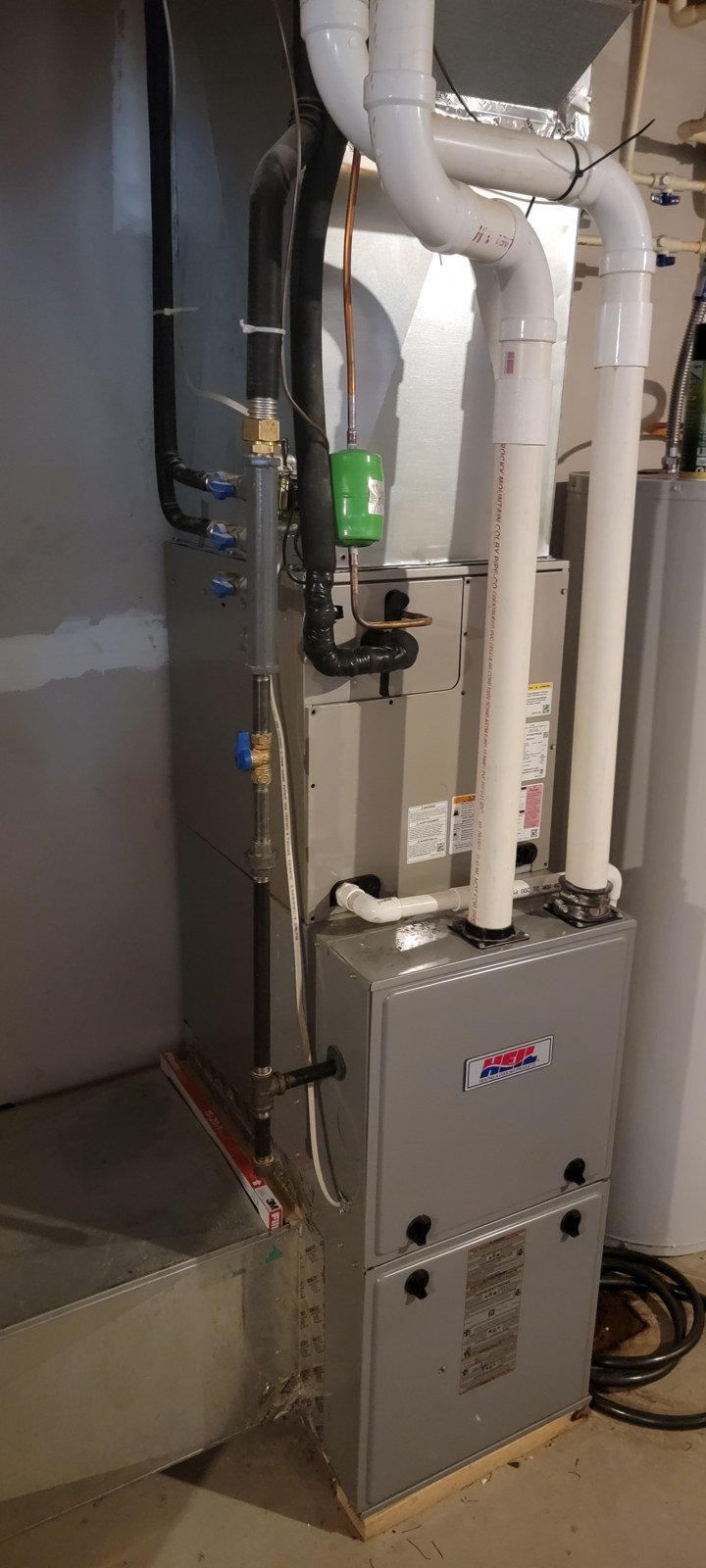
Work performed by founder Jacob Ward.
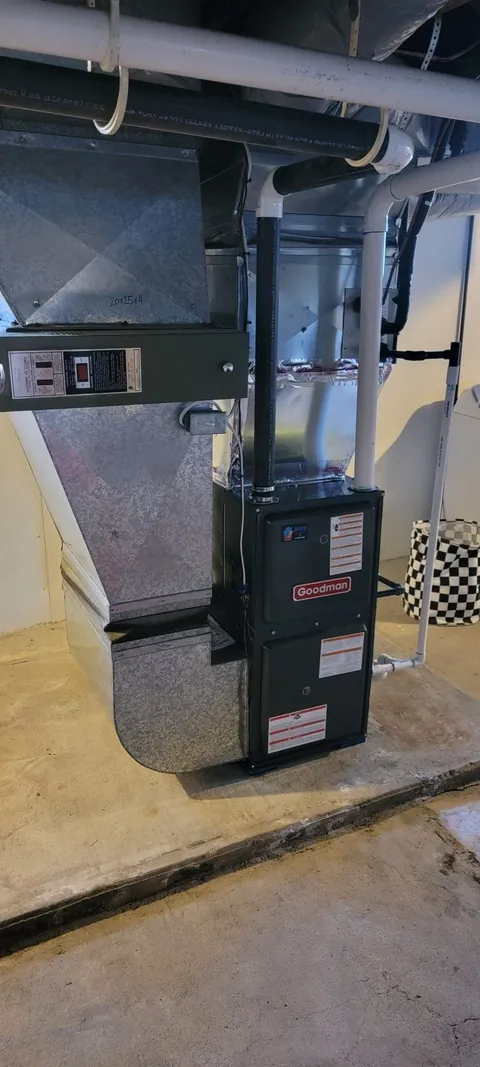
Goodman furnace installation — work performed by Jacob Ward
Goodman furnace installation

Heil furnace installation — work performed by Jacob Ward

Heil furnace installation

Questions about this service

Do you offer a second opinion on condemned equipment?

Yes. Contact us to discuss your equipment and arrange a free second opinion.

Do I have to approve a replacement during the visit?

We explain the findings, options, and price. The decision to authorize work is yours.

Do you service oil or steam heating equipment?

No. Ward Heating & Air does not service oil-fired equipment or steam heating systems. Our residential equipment coverage includes natural gas, propane, and electric systems.

What should I tell you when I call?

Share your name, town, full service address, equipment type and fuel type if known, and where the equipment is located in your home—for example, the basement, attic, or utility room. Describe what you are noticing, whether the problem is urgent, and when it started. You do not need to diagnose the fault yourself.

How much will my HVAC repair cost?

Repair costs depend on your equipment, the problem, and the parts and labor needed. Our diagnostic service charge covers a visit to your home to assess the issue and explain your options. We’ll discuss the repair price with you before any repair work begins, so you can decide how to proceed.

Do you offer free estimates and second opinions?

Yes. We offer free estimates for new equipment installation and free second opinions on condemned equipment. Call to discuss your situation.

Request furnace service

Call 412-629-3391 to talk about your home. For urgent heating or cooling help, call directly for 24/7 emergency service.

TEXT 412-629-3391 for routine service or installation questions. For emergency service, call directly.

Related options

All HVAC services · System replacements · Maintenance

Related information for your home

A furnace can also supply the airflow for central AC. Read about AC coils and matched cooling systems. For control questions, review thermostat compatibility and zoning.